


By Sylvia Fall
As a practitioner working on immigrant inclusion in a small city in Germany, I visited the U.S. to learn about welcoming in small communities.
But in the months leading up to my departure, I was uncertain whether I would actually encounter welcoming practices and policies—or even local officials willing to discuss them.
The national debate on migration was already heated, with the cancellation of diversity, equity, and inclusion policies and new national government plans to expand deportations dominating the headlines.
However, the reality I found during my visit was strikingly different from the national news. I was warmly welcomed by colleagues in local government, community leaders, and volunteers.
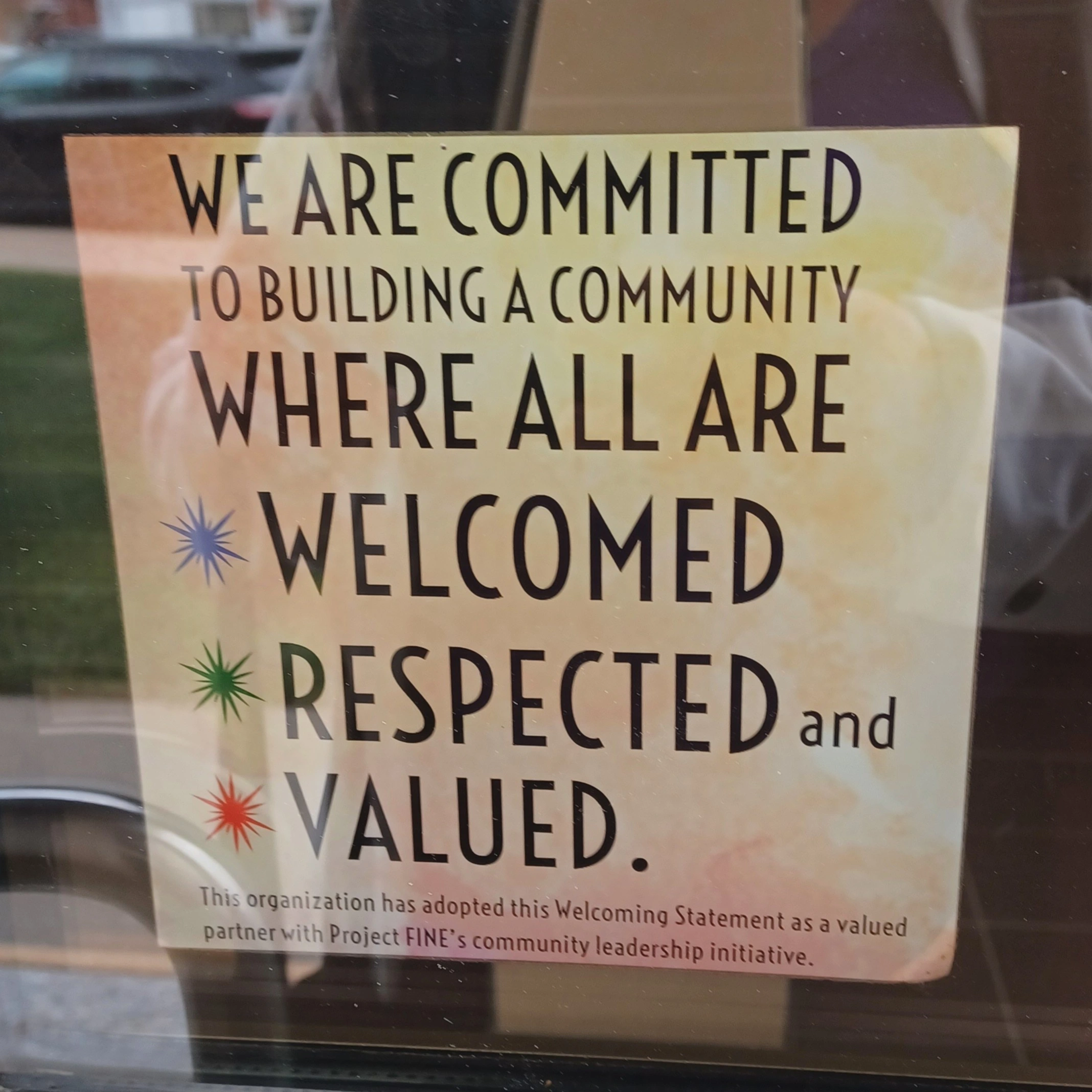
In the Winona County office building, a sign at the entrance door says: “We are committed to building a community where all are welcomed, respected, and valued.” Credit: Sylvia Fall
In smaller cities, where people know one another, communities see immigrants in neighborhoods and schools, joining local sports teams, opening small shops and businesses, enriching local culture, and building close relationships with long-standing residents.
Those who are deeply involved in welcoming work expressed frustration with the increasingly aggressive and divisive national rhetoric, which they felt had little to do with their lived experience and reinforced harmful stereotypes about migrants.
Yet, despite these challenges, everyone I spoke with remained steadfast in their commitment to their work. While the local debate is not free of controversy, it is shaped by everyday encounters and practical experience. I saw a widespread desire to bring historical context, nuance, and facts back into public conversations on migration.
During my visit in fall 2025, I had the pleasure of seeing several small cities in Minnesota, Iowa, Wisconsin, and Maine — including several Welcoming America members. Here’s what I learned.
Willmar, Minnesota
In Minnesota, I found compelling examples of how small cities creatively strengthen inclusion, build trust, and expand opportunities for newcomers.
Willmar is an agricultural city of about 20,000 residents in south-central Minnesota. Community events like Welcoming Week, alongside services such as interpretation and language classes, are creating an inclusive environment and connecting immigrants to the broader community.
These efforts are paying off. The Welcoming Week celebration on Sixth Street has become a beloved annual event, and a local high school recently elected a Somali-American student as their homecoming queen—a very American way of celebrating belonging!
Austin, Minnesota
Austin has developed a strategic welcoming plan that serves as a clear roadmap for making Austin a welcoming community with actionable ideas. One idea that stood out for me is the honorary City Council program to promote interest in local government.

Visiting a boba shop founded by young refugees in Willmar, Minnesota
I was also moved by leafing through a book available at Sweet Reads, a locally owned bookstore: Our Austin, Our America features portraits of community members paired with personal narratives and showcases the diverse population of Austin.
Lewiston, Maine
Lewiston has been transformed and reshaped economically, socially, and culturally with the arrival of Somali and Congolese immigrants over the past two decades.

Julia Sleeper from Tree Street Youth Center in Lewiston, Maine
Community leaders there actively challenge outdated stories about economic decline and instead highlight newcomers as key contributors to the economy and local entrepreneurship.
A big shift in changing attitudes toward migration is closely intertwined with an extraordinary event. In 2001, the Lewiston High School boys’ soccer team, with a large number of Somali immigrants among its players, made a surprising run to the state championship, uniting the whole city in pride—a powerful example of how sports can unify a community grappling with cultural shifts.
The Importance of Narratives in Welcoming
Narratives play a powerful role in shaping how people view migration and how communities respond to newcomers. Positive narratives are not about idealizing migration, but normalizing it.
Importantly, narratives empower migrants themselves. When they tell their own stories, they become agents of change, not a statistic or passive subjects of debate. This strengthens belonging and shows that inclusion is created with them, not for them.
The U.S., with its long history of immigration, is uniquely equipped to anchor these narratives in its national motto, E Pluribus Unum—“Out of Many, One.”
Sylvia Fall is the immigration affairs coordinator in the City of Emmendingen, Germany and co-spokesperson for the Migration Working Group, Association of Cities Baden-Württemberg. Her visit to the U.S. was supported by a McCloy Fellowship from the American Council on Germany, and advised by Welcoming International.